
Our Lady by Paul Kamish: Creating Notre Dame’s Iconic Blessed Mother
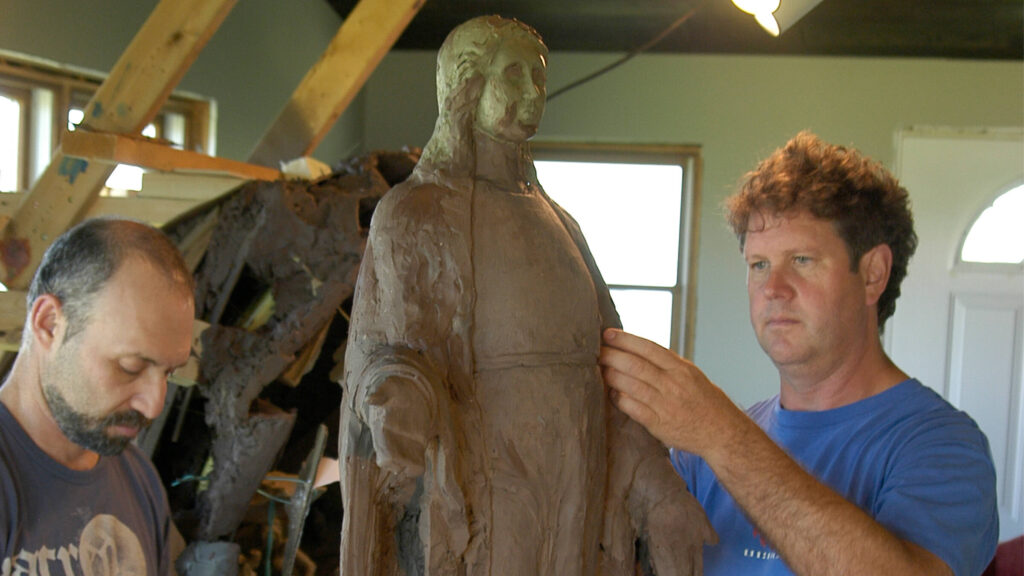
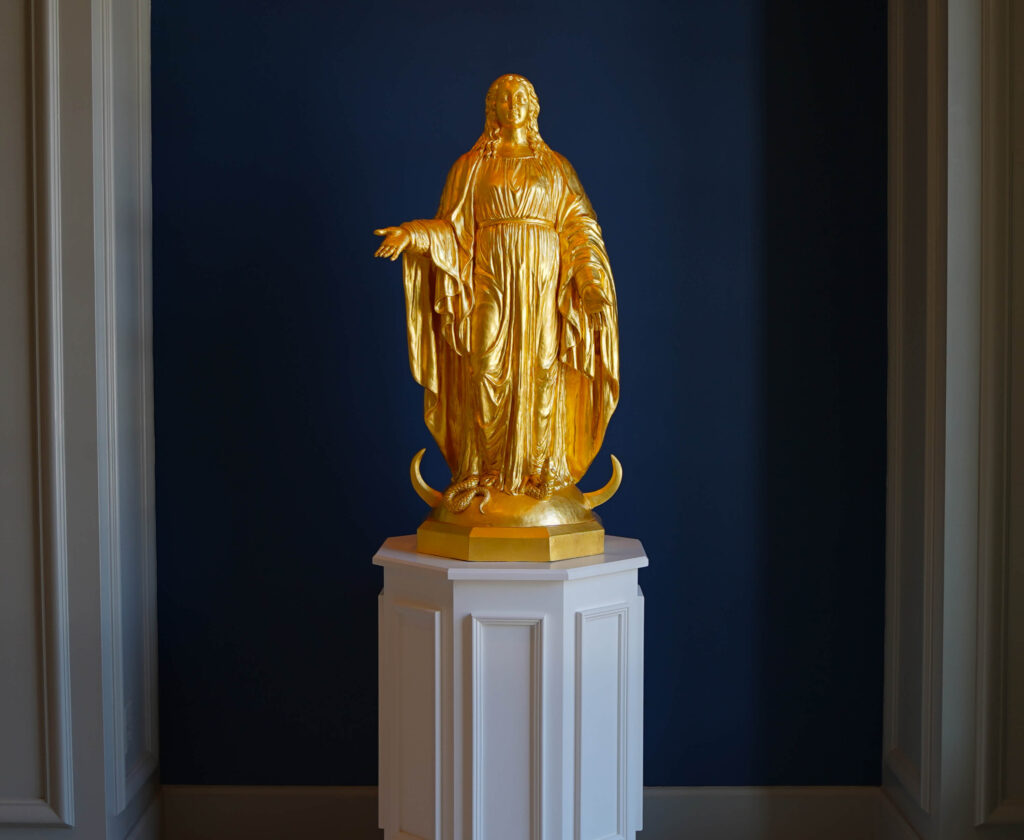
Our Lady by Paul Kamish is a 42-inch gilded bronze created for the University of Notre Dame, commissioned by the Development Department to bring the iconic figure from the Golden Dome into a scale that students, alumni, and visitors could experience up close. Two editions of the sculpture now reside on campus—one in the Morris Inn and one in the Development Offices—each finished in hand-applied gold leaf that mirrors the radiant form standing more than 180 feet above the Main Building.
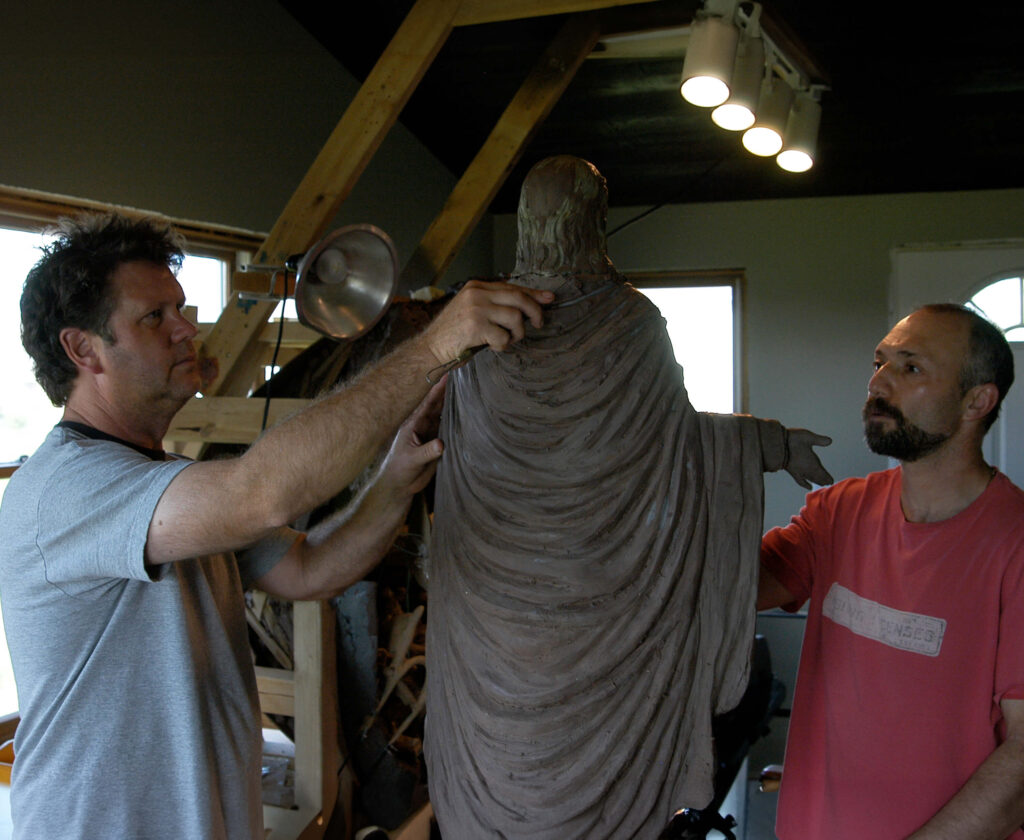
Sculpting Our Lady required the same faith-driven intuition that shaped the original: Back then, drones were not readily available, no crane access was available, there was little eye-level photography, there were only sketches and long-shot photos, there was archival study, and there was the artist’s ability to translate reverence into form. What began as a small clay maquette evolved into a monumental bronze, shaped through traditional craft and the belief that sculpture is a devotional act.
Our Lady by Paul Kamish Commissioned by Notre Dame
The University of Notre Dame commissioned Paul Kamish to sculpt a monumental representation of Our Lady in 2010, modernizing the historic image on the Golden Dome into a work that could stand within the community it represents. The commission called for a piece that honored the original nineteenth-century statue while embracing the artist’s own sculptural language—gesture, grace, and the quiet strength of the Blessed Mother. The result was a bronze cast through the lost-wax process, later gilded in 23.75kt gold leaf, echoing the luminous finish first applied to the Dome and statue in the 1880s.
The commission required accurate proportions at 42 inches, so Kamish relied on archival photographs and scaled drawings to interpret details not visible from the ground. The sculpture followed a full bronze workflow: clay enlargement, molding, lost-wax casting, metal finishing, and final gilding in 23.75kt gold leaf.
History of the Original Our Lady on the Dome
Before sculpting a modern interpretation, I wanted to understand the origin of the iconic figure known simply as Our Lady. The original statue atop the Golden Dome wasn’t made in Italy, nor was it cast in bronze, as many assume. It was created in 1880 by sculptor Giovanni Meli, an Italian-born artist working in Chicago, and cast in iron — a common material for monumental statuary during that era.
At approximately 19 feet tall and weighing more than 4,400 pounds, the statue stood as an extraordinary technical achievement for its time. For nearly three years, while the new Main Building and Dome were under construction following the devastating fire of 1879, the finished statue sat on the front porch of the building — an almost surreal image: the future crown of the campus resting at ground level, waiting for the world beneath it to be rebuilt.
In October 1883, workers used a block-and-tackle hoist system to raise the figure piece by piece more than 180 feet into the air — without modern cranes, without engineered rigging, and without the machines we now consider standard. It was strength, patience, and determination made visible.
A Gift by Women — A Legacy of Giving
One of the most meaningful aspects of the original Our Lady isn’t its size or engineering, but who paid for it. The statue was funded by the alumnae of Saint Mary’s College and the Sisters of the Holy Cross, each Sister contributing around $20 — a remarkable sum at the time. Their combined effort became one of the first major philanthropic gifts made by women to the University of Notre Dame.
That gesture matters. The Blessed Mother on the Dome has become a symbol not only of faith and identity, but also of the power of women shaping the University’s future long before women were admitted as students. Their gift still stands at the highest point of campus.
It is profound to consider that when students walk toward the Dome today, they are walking beneath a symbol given in love, sacrifice, and conviction.
The Gold That Defines Notre Dame
When the statue was first raised into place, it was not gilded. The early Board felt that covering both the Dome and the Mother in real gold was too extravagant, especially for a school still recovering from a fire. But Father Edward Sorin refused to accept anything less. He believed the University should shine — literally — with the brilliance of real gold leaf, not imitation coatings or painted finishes.
In 1886, gold leaf was applied to the statue and Dome for the first time, funded through special collections. That bold decision established the visual standard that defines Notre Dame today. Since then, both the Dome and Our Lady have been regilded more than 12 times, most recently in 2023, when artisans applied 23.9-karat gold leaf across roughly 3,500 square feet of surface.
Gold leaf is a material of astonishing purity — hundreds of atoms thick, so thin that 350 sheets equal the width of a hair. One ounce of gold can cover nearly 300 square feet. When sunlight strikes the Dome, the glow you see is the result of thousands of sheets of gold, hammered to almost impossible thinness — a glittering skin that has defined the campus skyline for more than a century.
Sculpting a Modern Our Lady
When Notre Dame commissioned me to sculpt Our Lady for the Development Department, the intention was clear: bring the presence of the Blessed Mother from the sky to the ground, into a form that people could stand before, study, and connect with personally.
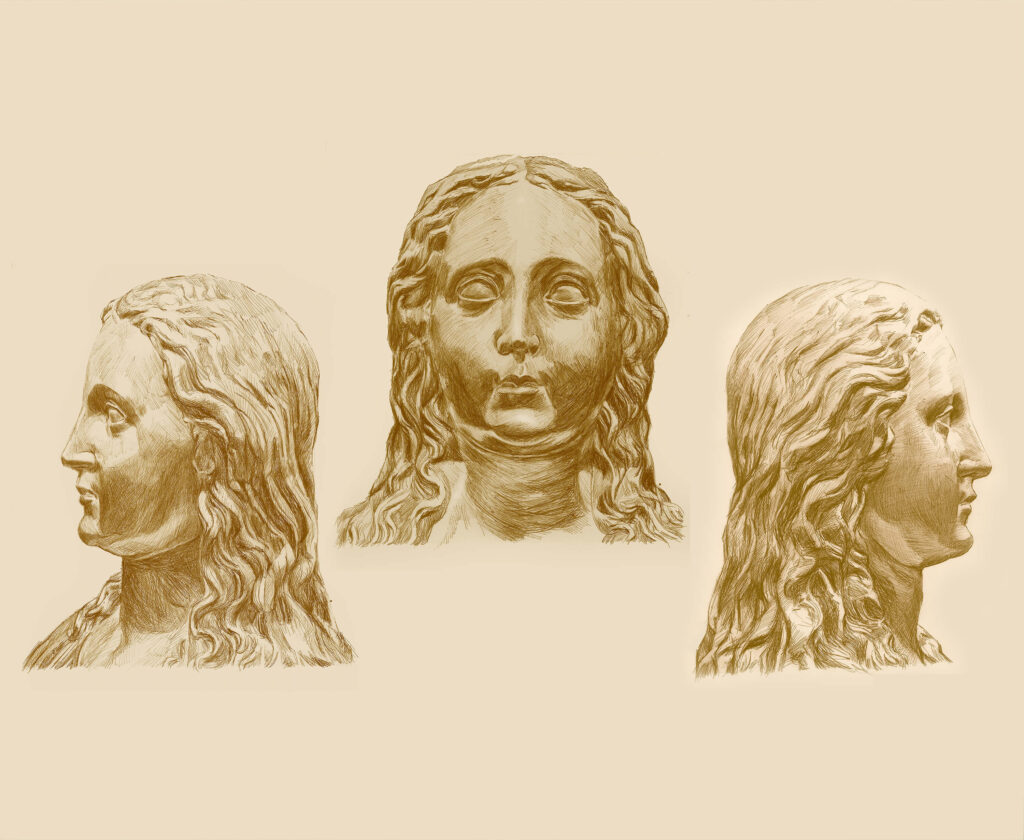
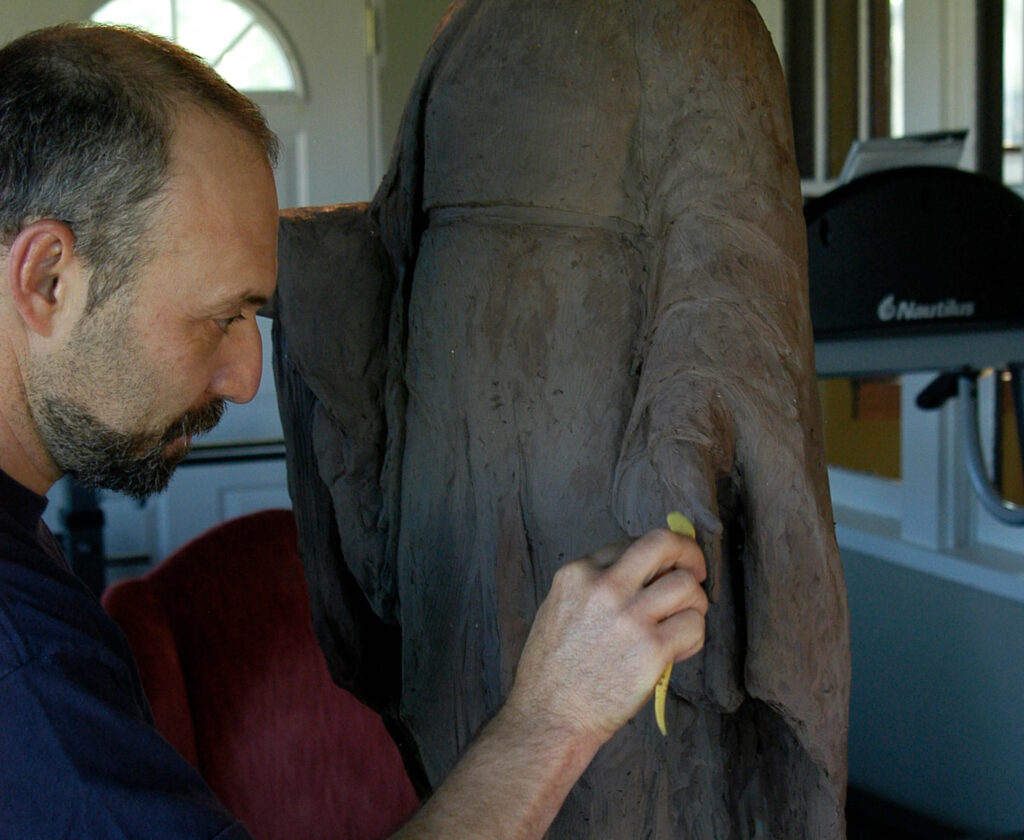
The process began with a small clay maquette — the essential gesture of the sculpture. In the maquette, I established the upward motion of the cloak, the protective stance of the body, and the flow of the garment, which needed to feel like real fabric animated by spiritual presence. Without high-resolution references or direct access to the original statue, I relied on a sculptor’s instincts — the way weight travels through the feet, the mechanics of the shoulders beneath heavy drapery, and the subtle arc of the neck that conveys serenity.
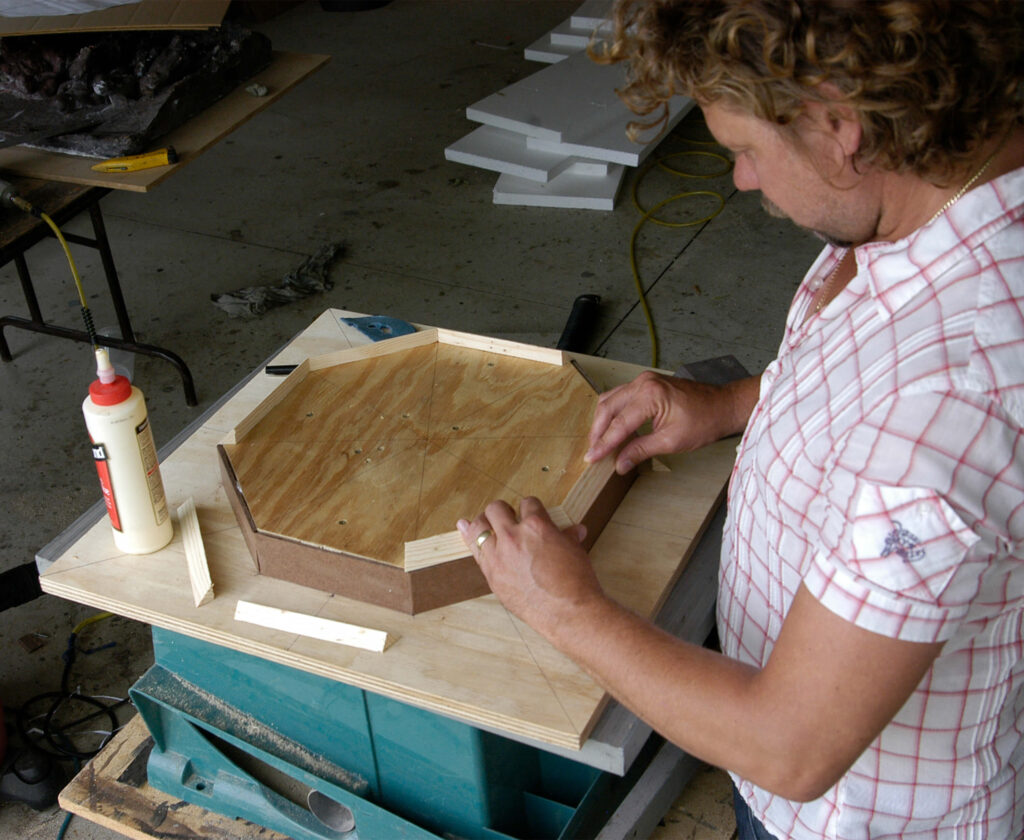
From the maquette, I scaled the piece to 42 inches and sculpted every element by hand. Once cast in bronze, each edition was gilded in gold leaf, a slow and delicate process requiring precision, discipline, and patience.
Today, two editions of Our Lady by Paul Kamish reside at Notre Dame:
- one in the Development Offices, where the commission originated
- one at the Morris Inn, where thousands of alumni encounter her during visits and reunion weekends
Both serve as contemplative spaces — quiet reminders that the image atop the Dome exists not only as a distant symbol, but as a presence you can stand before.
Together, the two sculptures extend the legacy of the original work on the Dome into daily campus life. The commission remains one of Notre Dame’s few modern interpretations of its most recognizable symbol.
A Legacy Carried Forward
In sculpting Our Lady by Paul Kamish, I wasn’t trying to remake the original — I was trying to honor its spirit. The statue atop the Dome belongs to history. My work belongs to the living community around it. It is a devotional interpretation, shaped by the same values that built the University itself: faith, craft, excellence, sacrifice, and the belief that some things are worth doing in gold.
Each time the Dome is regilded, the University reaffirms a lesson Sorin left behind: you never settle for half-measures. That spirit shines over campus every day. And for anyone walking past the Morris Inn or entering the Development Offices, Our Lady now shines at eye level — a reminder that what began in 1883 with iron, rope, and the generosity of women still inspires the work we create today.
Closing Reflection
When I sculpted Our Lady, I learned that devotion is expressed in gesture — not likeness. The Blessed Mother stands for protection, guidance, spiritual authority, and maternal love. My job was not simply to replicate her form, but to capture her presence.
Our Lady by Paul Kamish is a bridge between past and present — a modern expression of a historic symbol, created through traditional craft and the quiet stubbornness of art, the kind that insists on excellence even when it’s difficult.
The Golden Dome shines for a reason.
So should the work inspired by it.